Guide
Dual Refrigeration: How Two Cooling Systems Work
How dual refrigeration uses two compressors to hold a fridge near 38°F and a freezer at 0°F, and why it explains moisture, long run times and noise.
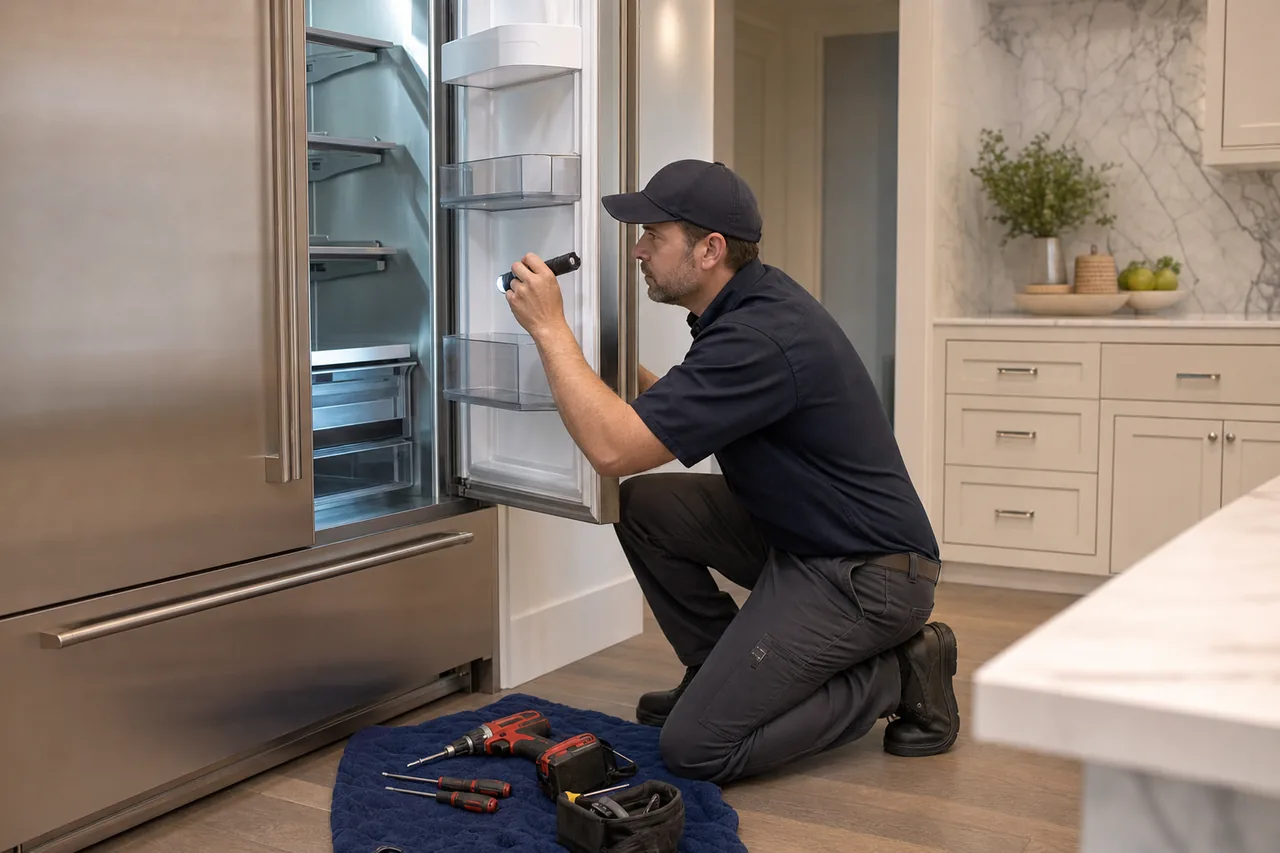
Dual refrigeration means a refrigerator uses two separate cooling systems, with two compressors and two evaporator coils, one sealed loop for the fresh-food side and one for the freezer. Because the compartments never share air, the fresh-food side can hold about 38°F with moist air while the freezer holds 0°F with dry air, and each side runs only when it needs to.
What does dual refrigeration actually mean?
A conventional refrigerator-freezer has one compressor and one evaporator coil behind the freezer wall. A fan blows that freezer-cold air through a damper into the fresh-food side, so the two sections trade air constantly.
With dual refrigeration, each compartment is its own sealed loop with its own sensors and controls. The fresh-food coil only has to reach refrigerator temperatures; the freezer coil runs much colder and serves only the freezer. Sub-Zero is best known for building this into its full-size built-in refrigerators. Paired column units from premium makers reach the same separation because each column is a complete appliance with its own system.
Why does the design keep food fresher?
- Humidity stays up. A freezer-cold coil pulls moisture out of the air as frost. A warmer fresh-food coil removes far less, so produce dries out more slowly.
- Odors stay put. Onion or fish smells can’t drift into the ice cubes, because no air crosses over.
- Temperatures hold steadier. Each side reacts only to its own door openings, so loading the freezer doesn’t warm the milk.
Why does a dual-system fridge sometimes look wet inside?
Moist air is the point of the design, so a light film of condensation on the back wall can be normal, especially after the door has been open on a humid day. The fresh-food coil also defrosts itself during its off cycle, and that melt water runs down a drain tube to an evaporation pan.
Water becomes a problem when it pools on shelves or under the drawers. The usual causes are a door that isn’t closing fully, a torn or flattened gasket letting damp kitchen air in, or a drain tube plugged with debris or ice. In Harrison, where July and August are muggy and many refrigerators are panelled flush into the cabinetry, a slightly sagging door or worn gasket shows up quickly as wet shelves.
Why does my refrigerator seem to run all the time?
Two compressors mean twice the chances of hearing one running, so a dual unit can sound busier than the refrigerator it replaced. Many premium built-ins also use variable-speed compressors that run long and slow on purpose, which is more efficient than short, hard bursts.
Constant running is only a concern when temperatures drift too. The most common reason is a dirty condenser: on most built-ins it sits on top behind the grille, where lint, pet hair and grease trap heat. Clean it about every six months. Next come leaking door seals, a failed fan and, less often, a refrigerant leak in one loop.
What noises are normal with two compressors?
| Sound | Usual cause | Normal? |
|---|---|---|
| Low, steady hum | One or both compressors running | Yes |
| Gurgling or trickling | Refrigerant moving through the coils | Yes |
| Sizzle or pop from the freezer | Defrost heater melting frost off the coil | Yes, during defrost |
| Clicking every few minutes | A start relay failing to start a compressor | No, call for service |
| Rattle or scraping | A fan blade hitting ice or a failing fan motor | No |
| Loud buzz from the top grille | Condenser fan strain or trapped heat | Check airflow first |
What does it mean when only one side gets warm?
This is where dual refrigeration helps with diagnosis. If the fresh-food side is warm while the freezer stays at 0°F, the fault is almost certainly in the fresh-food loop: its compressor, fan, control or refrigerant charge. If ice cream softens while the milk stays cold, look at the freezer loop, where a failed defrost heater that lets the coil ice over is a frequent culprit.
Before you call, check the set points, clear the vents inside the warm compartment, confirm the door swings shut, and look at the top grille for dust. If the warm side doesn’t recover within a few hours, move perishables to the working side or a cooler.
What does a repair usually involve, and what does it cost?
Most repairs on a dual system touch only one loop. Typical ranges in this area:
- Diagnostic or service call: $95–$149
- Common refrigerator faults such as fans, controls or start relays: $300–$750
- Defrost heater or defrost thermostat: $320–$550
- Sealed-system or compressor repair: $800–$2,200
These are typical ranges, not quotes; the firm price is given on site after diagnosis. Compare categories on our repair pricing page or read more about refrigerator repair. Harrison Built-In Appliance Repair is an independent service, not manufacturer-authorized; call (475) 471-0742 to book a visit.
Frequently asked questions
Is dual refrigeration worth having?
For households that buy fresh produce often or keep a full freezer, yes, because separate air keeps food moister and contains odors. The tradeoff is two sets of cooling parts to maintain.
Can one side fail while the other keeps working?
Yes. Each compartment has its own compressor and controls, so a fault in one loop usually leaves the other running, which buys time to save the food.
How often should the condenser be cleaned?
About every six months, and more often in homes with shedding pets. A clean condenser shortens run times and eases strain on both compressors.